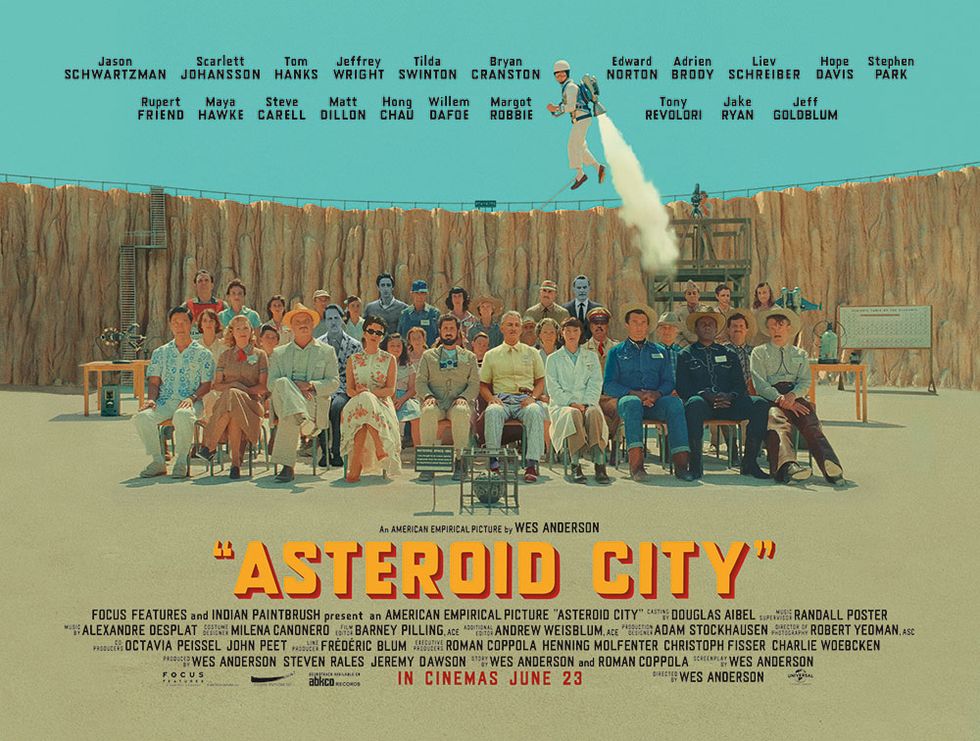
Asteroid City isn’t real. At least that’s what an unnamed narrator tells us. In the form of Bryan Cranston the man tells us the play we are about to see like all ideas starts with a writer. Writers that create imaginary worlds aren’t far from the norm with peculiar director/writer Wes Anderson. A man who for over two decades and ten films has a distinct voice for films if rooted in earth still feel light years away. Floating in their own ether, Anderson embraces both the nihilism and the optimism of his motley crew of characters and performers. With ASTEROID CITY he has encapsulated a careers worth of filmmaking. It is not him bookending his career but rather a self-tribute without pretentious attitude. For those that feel his films are unattainable this may not be the convincing element to prove them wrong, but for those that can both enjoy the peculiarity and look beyond will be given a delicate reminder of the thin line between performance and reality. Something Anderson may have been trying to see all along. ASTEROID CITY isn’t real. That is what the narrator claims. But the thing about narrators is…they’ve been wrong before.
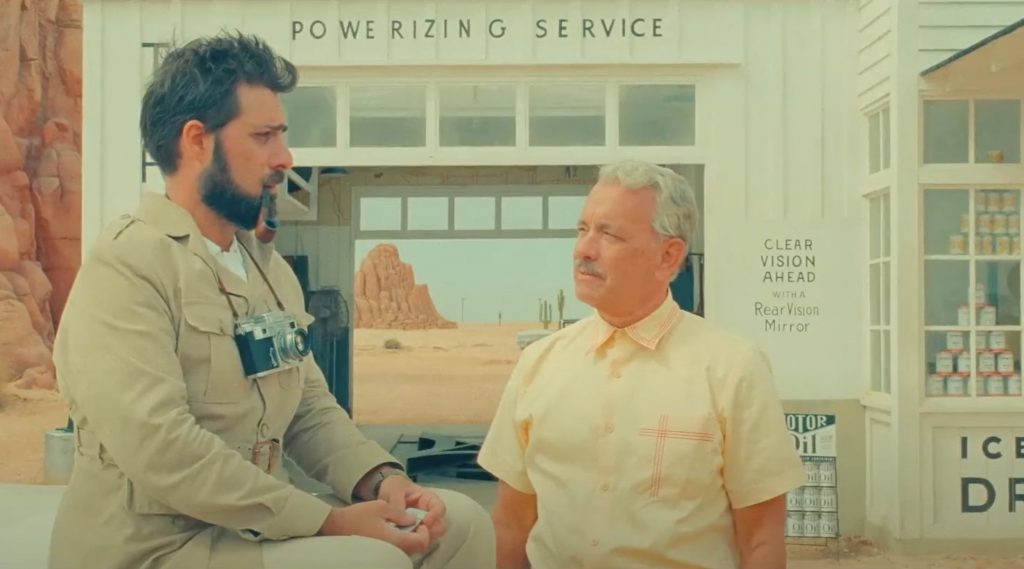
Jason Schwartzman has practically become synonymous when mentioning Wes Anderson films. Starting off in 1998 with “Rushmore” Schwartzman has grown alongside each starring or recurring role in Anderson’s works. So his face appearing fully bearded and with a smoking pipe is the least surprising thing. Schwartzman is Augie Steenbeck a war photographer (with the shrapnel to prove it) who has brought his four children to Asteroid City. His son Woodrow (Jake Ryan) is there to attend a Junior Star Gazing program with some other brilliant teenagers. Things would be bright for this family in this extremely bright desert town if it wasn’t for their broken down car and the fact that Augie has informed his children of their mother’s passing three weeks late. Her ashes in a Tupperware Augie is the kind of widowed father who already doesn’t know how to step up. His father-in-law Stanley (Tom Hanks) liked but never loved him and feels his need (and burden) to come pick up his grandkids for a better California life. Anderson has always played with the roles of fathers and most of his men lack the resources and love required for the job. With Augie however, Schwartzman gives us a mixture of both deadbeat and resilient. His grief is with him constantly but for every step he takes away from his children he always extends his arms back to hold them. As the film itself jumps back and forth between Augie the character and Augie the performer (an entirely different person) we see a man grieving as a character but as the actor portraying he expresses difficulty in understanding all his character’s motivations. In Augie there is this ability to channel well known plays such as Our Town or Waiting for Godot. Seeing life from outside in even if you are entirely unsure of the results.

But before Augie can get outer body perspective his time in Asteroid City must be experienced. Here he encounters an array of characters arriving with their own genius children. There is Hollywood actress Midge Campbell (Scarlet Johannson) whose daughter Dinah (Grace Edwards) becomes an immediate attraction for Woodrow. Then there is aggressive J.J. Kellogg (Liev Schreiber) and his son Clifford (scene stealing Aristou Meehan), and the last of the junior stargazers Shelly (Sophia Lillis) and her mother Sandy (Hope Davis). Everyone is overseen by general Grif Gibson (Jeffrey Wright) who spends most of the children’s time parading his own accomplishments and stories. Asteroid City itself a town obsessed with its own history (its claim to fame was an asteroid that landed hundreds of thousands of years ago). But it is the perfect spot for government and scientific experiments as well as the local motel (run by Steve Carrell). Like his last few films Anderson’s cast is extensive but major credit to his writing that not only allows everyone to get their moment he builds a strong emotional bond to nearly everyone. Every performer brings such a gravitas to their role that they become both scene stealers and main focal points all in one. ASTEROID CITY is also Anderson’s most beautiful looking film in years. Robert D. Yeoman’s cinematography is ant antidote for all the too hard to see films of lately. Bright in every frame, the film’s wide scope allows every bit of frontier production design to jump off the screen. Imagine your favorite Road Runner Looney Tunes episode come to life mixed with the Country Bear Jamboree. Hell the film itself stars a jamboree band with some very familiar Anderson veterans.

As ASTEROID CIY reveals its true intentions, in a wonderfully galactic extravaganza, Anderson has not just his characters but also his audience ponder what we are all doing this for. It is a grand question that in a lesser filmmakers hands would garner some eye rolls. Anderson isn’t asking us the meaning of life, but more specifically your life. Not if it has value but instead at what point do we stop being performers and find acceptance. Maybe we never do. As the curtain peels back and we learn of the plays writer and director (Ed Norton and Adrien Brody respectively) we come to see that while somebody is at the helm that does not mean they have to dictate all. Brody as the aggressive director Schubert Green finds more comfort in allowing himself to be dressed by the wardrobe department, shaved by hair and makeup and lives on the couch of the sound stage. He is our own aggression and our ability so settle but still feel anger over it. Norton as Conrad Earp the writer is a calmer more precise being that understands the need to ask for assistance. In a recurring yet gripping moment he asks his troupe to help him create a scene by pretending to be asleep. Maybe then his writing can be woken back up. If Conrad and Schubert are our two halves they are ones that don’t battle one another but rather coincide to create our daily performance.

Performance after all is what Asteroid City is rooted in. Even when an outer world visitor finds his way into town their first instinct is to perform for everyone. It is a humorous way of asking if it is our instincts that make us always want to perform or is it just a requirement when being down here on Earth. If we are always performing how do we ever cope with real emotions. As Augie acts out and continues to question the purpose we find that his children, especially his three adolescent daughters find easy ways to mourn their mom. Augie seeks solace though Midge, his father-in-law’s approval and eventually with someone who thought was lost to him forever. ASTEROID CITY grows chaotic as its finale gets closer, but maybe that is what happens when performance slows down and reality takes in. The understanding that while both can and will always exist together there is still a way to find peace in the middle. To realize that whether it is in the stars or down on Earth our roles cannot disappoint even if seeing our own purpose isn’t clear. Augie tells Midge early on that every picture he takes comes out, but as much as we wish our lives could be the same, some things will always remain alien to us.
A
ASTEROID CITY WILL BE RELEASED IN SELECT THEATERS JUNE 16 AND IN THEATERS EVERYWHERE JUNE 23
 No assembly RequireD
Leave a comment