
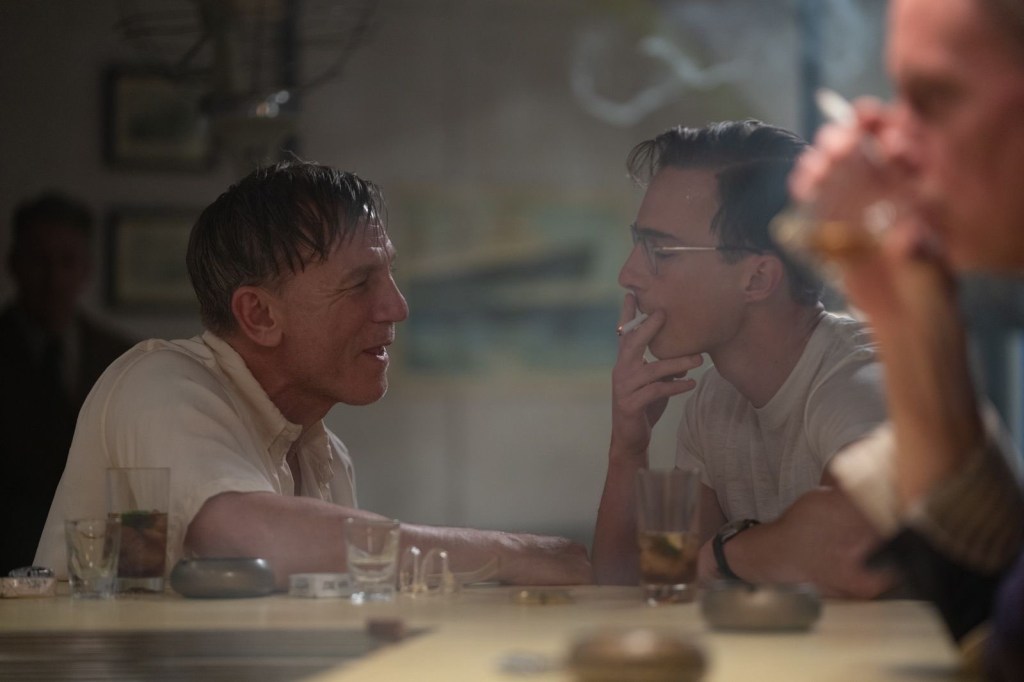
Unrequited love can be addictive. For many trying to give love to another and not having it returned only strengthens their feelings, but most of us know these feelings can never fully be embraced if they are not mutual. Instead feelings of love become desire and sometimes a cause of our own pain. Luca Guadagnino’s films know a thing or two about desire and love returned and love rejected. A filmmaker who continues to push past their own previous films to both expand and create characters we feel fully connected to long before the credits roll. Guadagnino, a filmmaker who lives for the challenge has allowed his latest film to be an uphill battle tackling one of the most prolific and obscure writers of their respected generation. William S. Burroughs, a post modern and possible founder of the beat poet generation was a writer whose work feels like an enticing kaleidoscope of addiction, curiosity and exploration of both he mind and the actual world. Even in its often broad topics of men trying to re-discover a new America (often by leaving it), Burrough’s work is still so specific and unique with its touch of lunacy that adapting his works is like creating your own novel from scratch. QUEER, the latest film from Guadagnino (and written for the screen by Justin Kuritzkes) does not just have the daunting task of adapting one of Burroughs incoherent works, but also finishing the novel that even Burroughs himself claimed was never fully complete. But even with this battle QUEER becomes a beautifully surrealist prism of desire told through the loneliest of men. It does the impossible and not only finishes the novel but brings both a sense of stability to Burroughs through the performances all while completely twisting every inkling of sanity thanks to Guadagnino’s own obsession with desire. But once again for a film on unrequited affection there is nothing less than absolute love for QUEER and even more so for Guadagnino.
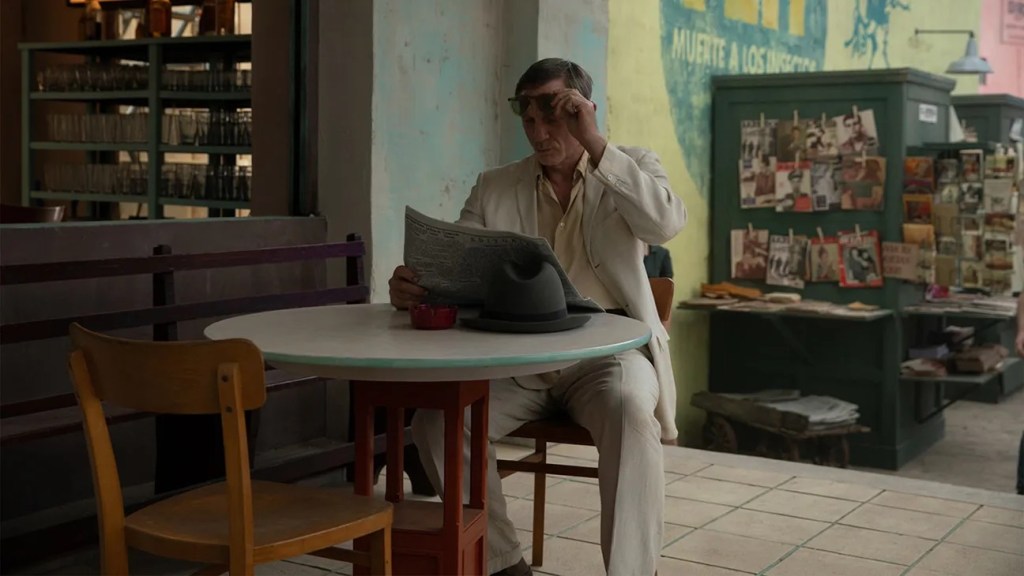
William Lee is lonely. Portrayed by former James Bond Daniel Craig, Lee (as he prefers to be called) is less of a departure for Craig’s previous roles and more a consistent portrayal of broken men often at their own hands. Lee stumbles around Mexico City with the swagger of a fucked up personification of Burroughs himself (Queer and many of Burroughs works often fictionalized his own self in his leading men) dripping sweat and not just because of the central American heat. Lee an alcoholic and a full time drug user (heroin being the drug of choice) tries to present himself with panache dressing appropriate for the 1960’s era but looking like an evil tycoon who would hunt down Indiana Jones (or Bond perhaps?) Guadagnino and his cinematographer Sayombhu Mukadeeprom create a visually vibrant Mexico that thankfully avoids most of the standard orange sky tropes associated with a depressive state of Mexico. Perhaps its due to not just the liveliness of the the story but in part to these being a sanctuary for these men to run free and believe they are avoiding all their troubles from America. But Lee takes avoiding to another level. His days are spent bar hoping but mainly his homestay called the Ship’s Ahoy, were he throws back shots of tequila less like they are water and more like they are the only thing fueling his blood stream. He discusses nightly sexual encounters with friends (including hysterical and unrecognizable Jason Schwartzman who is basically cosplaying as his uncle Francis Ford Coppola). These encounters often revolve around men twenty years his junior whether they be locals or one of the many ex-pats who have fled to Mexico post war. So it is not surprisingly when Lee is caught off guard by the gorgeous and quit Eugene “Gene” Allerton (Drew Starkey) across the street, and more specifically across the crowd of a cock fight. Guadagnino is both being quite comical with a pun (and on the nose) first encounter as well as including one of the best needle drops in recent memory to accompany this moment. Anyone who has ever wanted to hear a Nirvana song blast through the speakers during a 1960’s queer period piece, well boy do I have the movie for you.
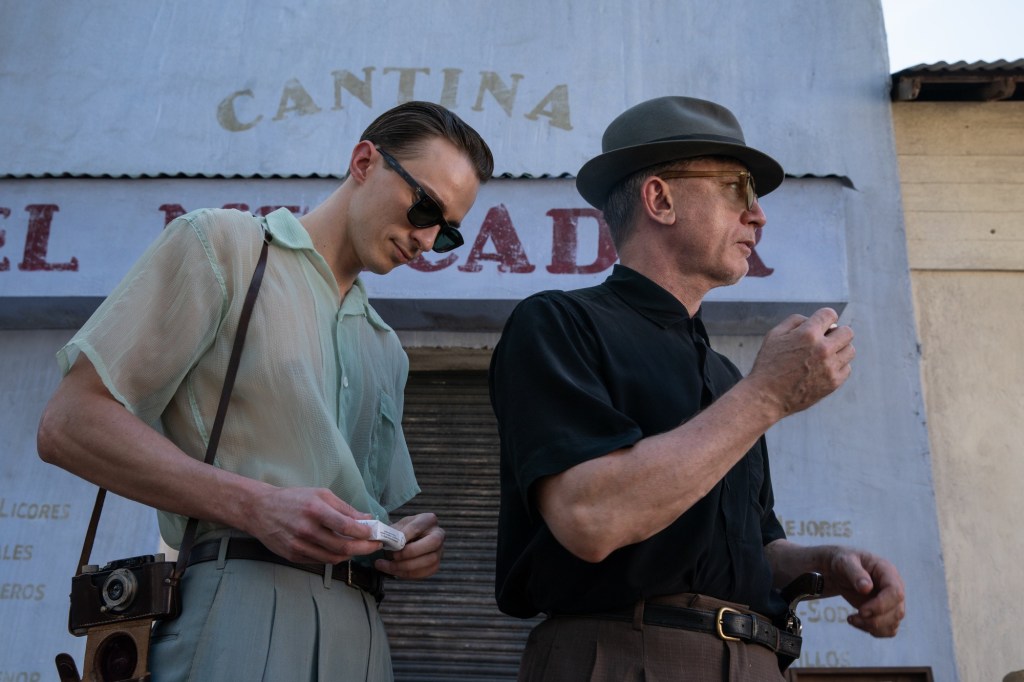
QUEER told in chapter format (less chapters than the book but somehow twice as long) avoids the drawn out feeling that often accompanies chapter films thanks in part to its divide of both character development as well as imaginative filmmaking. Lee is a mess and seeing his early interactions with Gene is both humorous and upsetting due to Craig’s performance of a truly broken man. Craig one of our finest actors melts into Lee with every shot of tequila and cigarette smoke burning into his skin. To say it politely he looks terrible which is a praise far beyond other films who refuse to hide their handsome leading men. Craig is far from hard on the eyes as a person but as Lee the addict the empty is there but the willingness to want to be around him is nonexistent. It’s a tremendous performance that Craig excitedly has to hesitation to engage with wholeheartedly. Balancing this is Starkey’s ability to bounce off Craig’s Lee with curiosity but also knowing what he’s in store for. Gene is no idiot and while he accepts many of Lee’s advances Starkey carries a great sense of balance with Gene as both through curiosity and a stern attitude. Starkey best known for his villainous role on the Netflix YA show “Outer Banks” proves beyond this as an actor that gets his own “star is born” moment. There is a confidence that comes from someone more veteran than him and yet still able to have the vulnerability and intrigue of someone in the business far from jaded. It allows for the film to explore more intense and intimate moments without any prejudgment but instead total trust in your director and even more so your co-star. Guadagnino has been playfully criticized before for his lack of visual acknowledgement of his more intense sex scenes. The remarks being that his still most popular film “Call Me By Your Name” panned to the window far too often not allowing a gay romance film to actually show the lovemaking so enticing to the performances. QUEER however is Guadagnino having the last laugh. Prolonged sex scenes between Lee and Gene do pan to the window only to quickly cut back in a manner solely made for Guadagnino’s own ability to have a quick chuckle at us. The scenes however are shot with ferocity as Lee and Gene’s bodies blend into one as (now a Guadagnino staple) Trent Reznor and Atticus Ross’s score absorbs every movement.

Lee and Gene as well as the film itself may want to build this connection but Guadagnino and Kuritzkes script always knows to keep them at a distance. Lee’s addiction to both the drug and his love for Gene reminds us the impossibility of true attachment. But even with the film acknowledging the difficulties of true love for one another and the self it is fascinating to witness Lee’s never ending journey to find ways to fully love Gene and receive that love in return. Anyone who battles addiction or knows someone who does is aware of an addict’s never ending journey to find completion. Even if they’ve accepted their inability to overcome their disease there is still a longing for a fix all substance. Lee’s journey to fixation (although showing no signs of wanting to be clean) involves finding a mysterious herb that can is told to be able to allow telepathic communication. The herb in question is ayahuasca, a psychoactive beverage which to modern audiences has become more associated with white people traveling to native land in order for some sort of guide awakening. Sometimes its achieved other times its another example of how cultural appropriation reigns high amongst modern and often privileged whites seeking discovery beyond responsibility. Lee’s journey for this leads him and Gene deep into the jungle in a final chapter that delivers another unrecognizable actor in Lesley Manville’s Dr. Cotter (donning a smile and teeth that resemble more the naked old lady in the Shining than anything else). These moments allow for Guadagnino to show how while its topic of queer love may feel in the realms of “Call Me By Your Name” the appropriate spiritual successor is to his remake of “Suspiria.”

These moments of psychedelic connection are both visually terrifying and sensual in a way that far exceeds Guadagnino’s previous works of seduction. With a full visual effects team, QUEER finds itself both proving and disproving its own theories of connection. It shows the possibility of connection not just through the heart and body, but also when emphasized by the usage of a drug that alters the mind (or perhaps leaves it clear). It even allows for Guadagnino to repeat another infamous scene involving a more aged person reminding someone younger that they should take a chance on love where others never have. To see Gene receive this advice shows the film’s intentions of wanting a successful partnership but knowing all participating parties must know themselves. But QUEER is a film that also wants to question itself because if Gene must find himself before he can love Lee how is he supposed to ever fully accomplish that if loving Lee must come first. Its less do or die and more so die or die as QUEER saves its most surreal moments to show how even in our final breath there is still questioning and regret. It does not mean it is the end for either Lee or Gene but rather a possible ending that could be because again this is the finale even Burroughs never gave us. Instead QUEER becomes and adaptation to possibly correct some personal mistakes of a writer and his too far gone characters. Guadagnino however he corrects these mistakes still knows if only it worked from the beginning then things could have been different. Too much has already occurred and the initial connection was never honest. Instead we are left with Kurt Cobain as his lyrics belt out in a reminder to “Come as you are, as you were. As I want you to be.” It is easier said than done.
A
QUEER SCREENED AT THE NEW YORK FILM FESTIVAL IN THE GALA SECTION. IT WILL BE RELEASED IN THEATERS NOVEMBER 27 FROM A24
 No assembly RequireD
Leave a comment