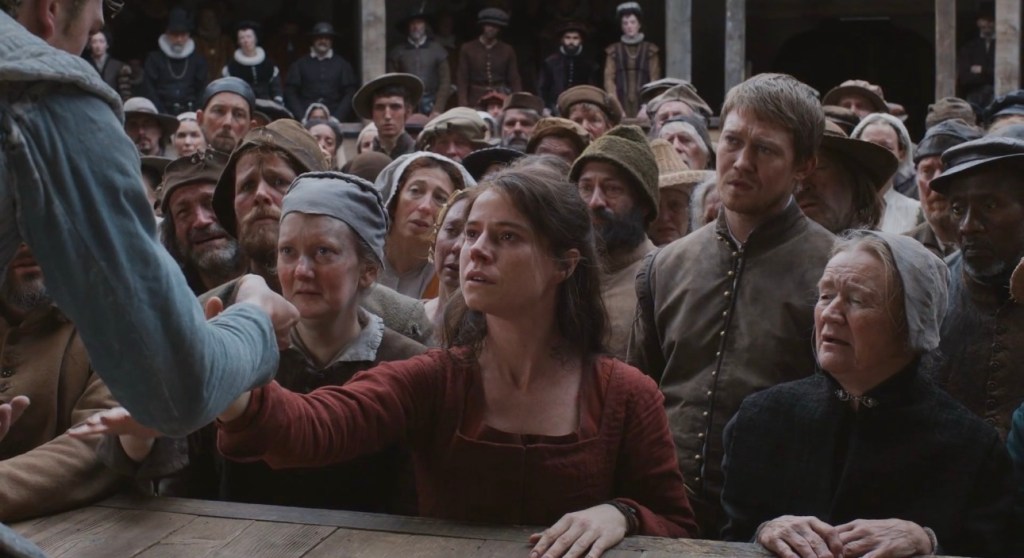

Art can heal all. While many artists will stand by this idea, art being a cathartic tool also means great pain must be put in. But above the pain what must always be put in great art in other to create any sense of cathartic release is truth. HAMNET from Academy Award winning director Chloé Zhao is a film that has a peculiar relationship with the truth. Adapted from the book of the same name from Maggie O’ Farrell, HAMNET tells the historically fictional version of William Shakespeare and his wife Agens as they grapple with the loss of their only son Hamnet. But while scholars have never been able to confirm or deny the circumstances and outcome of the passing of Hamnet, the film knows the truth is in the heart of the beholder and real beauty can come from this feeling. In doing so HAMNET can be seen as a centuries made later form of catharsis for both William and Agnes (better known as Anne in historical sense) but the film also seems to be hellbent on forcing its audience to feel what it wants it to feel rather than allow them to create their own genuine moments of truth. A weeper of a film HAMNET is far from tragedy-core and in fact makes a solid argument for not allowing films to just be comfortable (especially in a time of great unease), but it also falls victim to its own misfortunates by displaying constant vignettes of heartbreak without any moments to consume what has transpired. In doing so HAMNET unfortunately becomes the kind of film that an Oscar-bait hungry audience flocks to only willing to engage with what is on the page (or scroll) and never attempts to seek further. A film that makes you sad because it told you to be so and how dare you reach for anything more. For a film that is seeking the truth HAMNET spends more time in its desire to corrupt the emotions rather than let one’s heart interpret their own. The bard himself knew better, but then again there is a reason his work is timeless while HAMNET seems destined for a year’s worth acclaim before getting lost to history.

There is very little more entrancing than the period when two people are falling in love. Those early stages of mystery and intrigue. For Agnes (Jessie Buckley) and Will (Paul Mescal) this means secret rendezvous in the barn of Agnes’ family home and Will removing himself from his abusive and highly religious family to escape to the woods where Agnes feels a spiritual connection to the earth and all its offerings. HAMNET early on is a seductive and stunning portrait of love and lust in the hearts of two outcasts that are beyond the confines of their aggressively conservative upbringing. Mescal and Buckley’s chemistry is undeniable as the two performers have already established more than respectable careers. But what makes their performances in this early stage of the film the more exciting is watching two often serious performers allowed to be let loose slightly as they woo one another with both their words of beauty and their physicality. Mescal delivering a sexiness to Shakespeare this side of Jospeh Fiennes, and Buckley never playing Agnes as a rebuttal of Will’s desire but rather a playful wit that evokes the same passion for Will. For both of them they represent fresh ideas beyond their worlds. What more could people want in a time of limited discovery? In these moments HAMNET plays as a sort of “Back to the Future” flashback where while Shakespeare is far from one’s relative it is still fascinating to imagine this world where the future playwright master gets to be a real person full of desire, hope and fears. While Agnes’ excitement defines time as her connection with nature allows her to see both a future with Will beyond these realms.

All this joy can comically be seen as the time before the fall. And while any loving parent will balk at the idea that kids ruin lives, there is a distinct whiplash of reality that HAMNET reveals when Agnes gives birth. The film already full of real life struggles (money, faith, family disproval) still uses the birth of Agnes’ and Will’s children, including twins Judith and Hamnet (Olivia Lynes and Jacobi Jupe respectively) as the setting for the horrors that come with fearing for your child’s life every day. But Zhao with a screenplay she adapted with O’ Farrell lays the pain on so thick that it suffocates not just the actual children in the film but the entire essence of wanting to understand your own relation to what is transpiring. Agne’s daughter Judith gets sick and is close to death. We know this because it is constantly reiterated that Judith will die. But even the most unfamiliar of audiences is ahead of the game knowing it will be Hamnet who succumbs to illness. However instead of allowing Agnes or more so Buckley to display the feelings of this soon to be loss, Zhao is more interested in a showcase of Buckley that involves screaming and crying accompanied by Mescal shouting and slamming his fist. What is happening on screen is devastating but HAMNET almost feels angry at anyone who doesn’t feel an ounce of connection to what is happening on screen. It is less a film focused on creating empathy and more so one cocky enough to think everything is already earned. Sick children, even dead children is without question heartbreaking and deserving of tears, but a film to just assume can be seen as egregious.

When HAMNET does find Hamnet deceased the film is so far gone in its own ego that you may feel wrong for feeling numb. You’re not. It is here (and with somehow only forty minutes left, that also manages to feel like a lifetime) where HAMNET wants to express how the tragedy can define art. Not necessarily a last minute hail Mary idea as there is a blink and you’d miss it scene of Will using his lust for Agnes as inspiration for the infamous balcony scene in Romeo & Juliet. But even with this HAMNET’s final act feels like the film Zhao wanted to make more causing what can before to feel like a prologue that wanted to just be a text scroll in the opening credits. One feels cheated almost, not necessarily to go back to the happier times, but more so to at least build a stronger foundation in order to create more understanding. The death of a child will re-define anyone and of course it is going to break Agnes and Will, but again third act emotional manipulation feels in the same realm of a Pixar movie. Our characters are sad because something sad has happened and therefore you are sad too. How is that not enough for you dear audience!

But where HAMNET’s biggest emotional weight almost becomes comical is in its final act that shows the words of Zhao and O’ Farrell are truly limited. Using the tragedy of Hamlet to display Will’s pain may seem engaging, but HAMNET itself makes sure it is far from that. As Agnes makes the connection between her life and the tragic play it almost feels like a music biopic. Paul McCartney once cried on a street named Penny Lane so that’s why the song is named that! Will Shakespeare lost a son named Hamnet so that’s why the play is called Hamlet! Maybe it isn’t as eye roll worthy but once Zhao uses a needle drop as overused as it was in Villeneuve’s “Arrival” it certainly is hard to argue otherwise. It also doesn’t help that it is here where the script’s strongest dialogue comes into play simply because the words came from the Bard not the O’Farrell.

HAMNET may see itself more as emotional manipulation and most likely doesn’t believe it is in its heart of hearts. However there is such an unearned confidence throughout the film that infuriates especially when knowing art and more so film criticism is already reduced to the instant. A film that may leave one crying because in the moment what else is there to do? But upon further thought (something the film leaves little time for) it is clear HAMNET has little interest in exploring beyond the page and instead feels so satisfied leaving its small mark on the town before going to the next stage where audiences just want a cheap thrill.
C
HAMNET WILL BE RELEASED IN THEATERS NOVEMBER 26 FROM FOCUS FEATURES
 No assembly RequireD
Leave a comment